

Skip to content

NEO Websites

Sites of the future: maximally fast (Google scores close to a hundred) and built for AEO - visibility in AI search engines like ChatGPT, Perplexity and Google AI. On a dedicated SaaS application, with a built-in AEO audit.

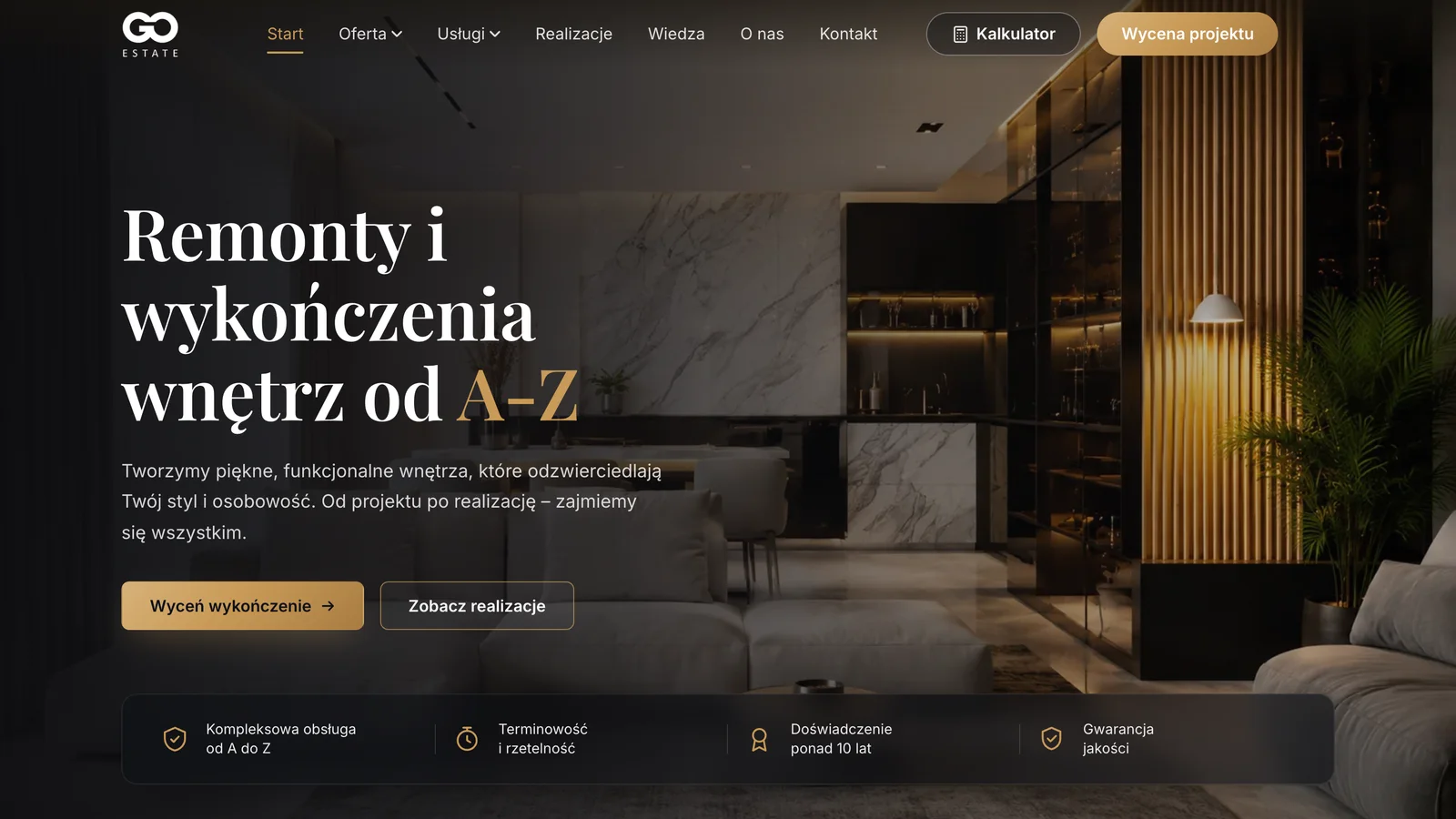
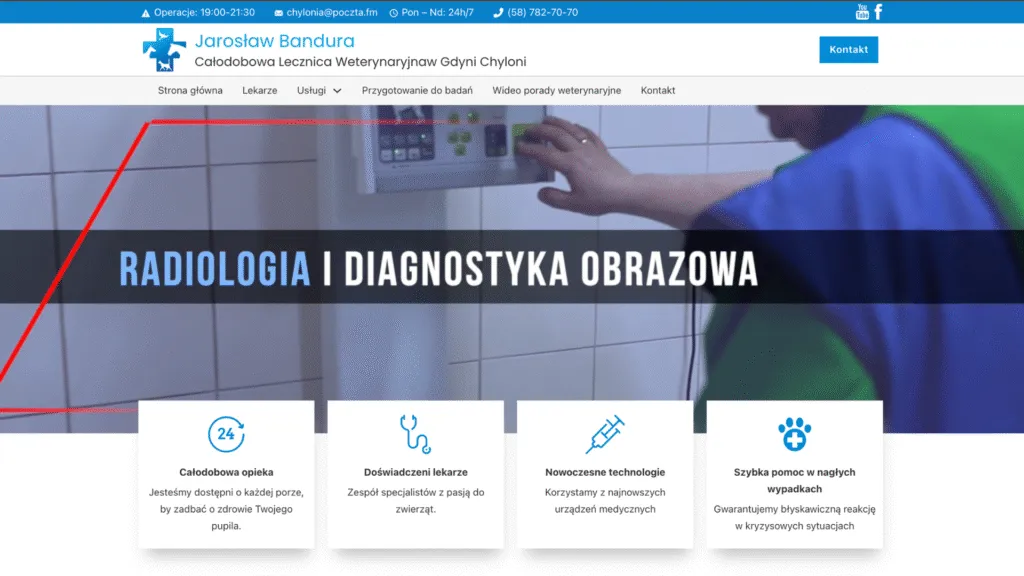
The GO-Estate website - turnkey interior finishingThe website of the 24-hour veterinary clinic in Gdynia ChyloniaThe website of Maciej Bodal's dental practice in Gdynia

Value

Why NEO

WebloNeo, the SaaS application behind NEO websites, was written by Dariusz Niemczak in Gdynia - not an off-the-shelf template, but a tool developed for the specific sites of my clients.

NEO Websites are my answer to how the internet is changing. They're sites of the future: extremely fast, lightweight and built from the ground up so that not only the browser but also artificial intelligence understands them. Instead of a heavy WordPress with dozens of plugins, I build them on a dedicated SaaS application that squeezes out maximum performance.

The effect shows in the numbers: my sites hold scores close to a hundred in Google's tests - 99 for performance, 100 for SEO and for best practices. That is my standard, not the exception. But speed alone is just the price of entry today - the real game is whether AI will recommend your company when someone asks about it.

  • 99 for performance and 100 for SEO - for real
  • Visibility in AI (AEO), not just in Google
  • A dedicated SaaS application instead of a heavy WordPress
WebloNeo - the SaaS application NEO Websites are built on

Client panel

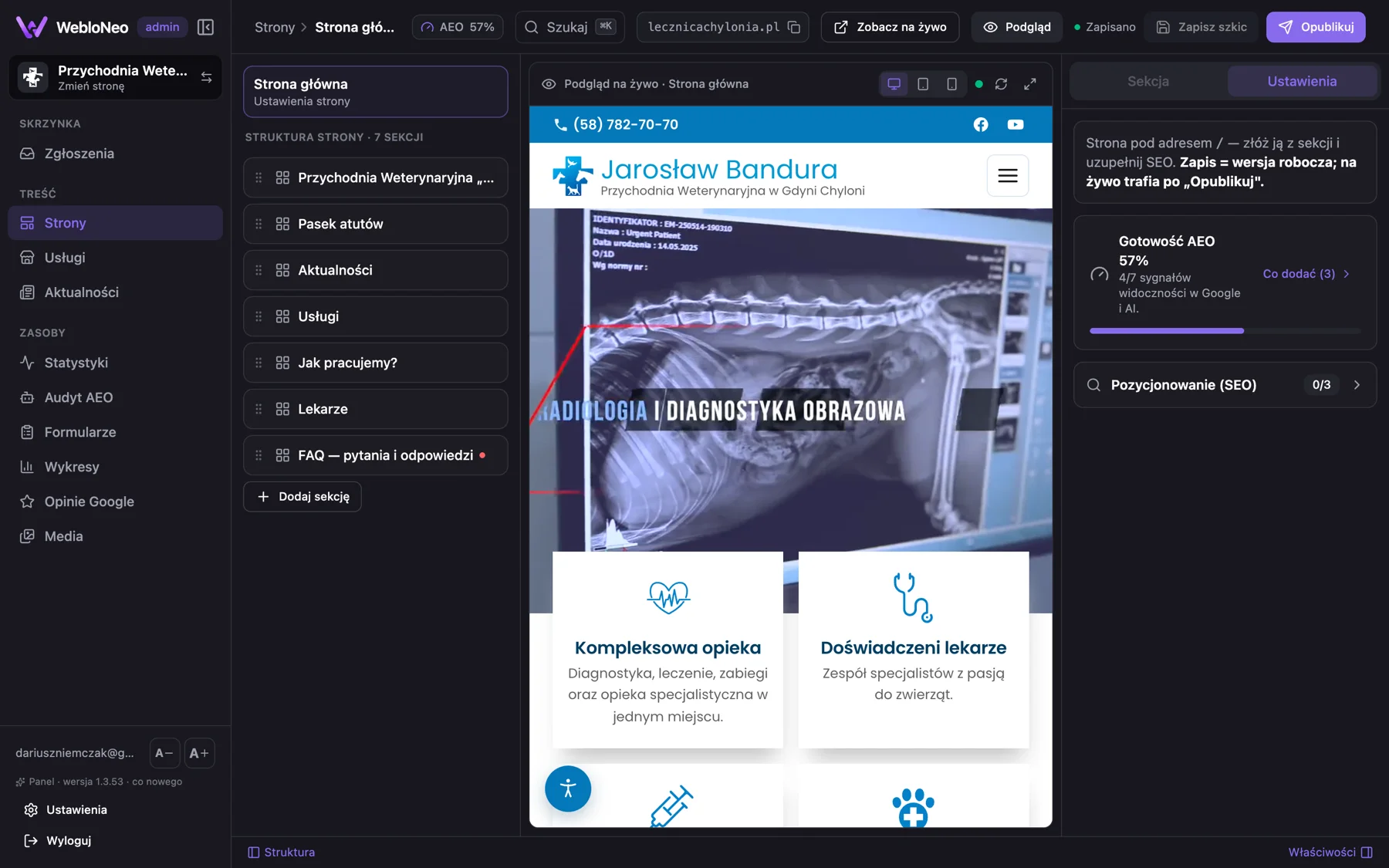
You run the site yourself, from the panel

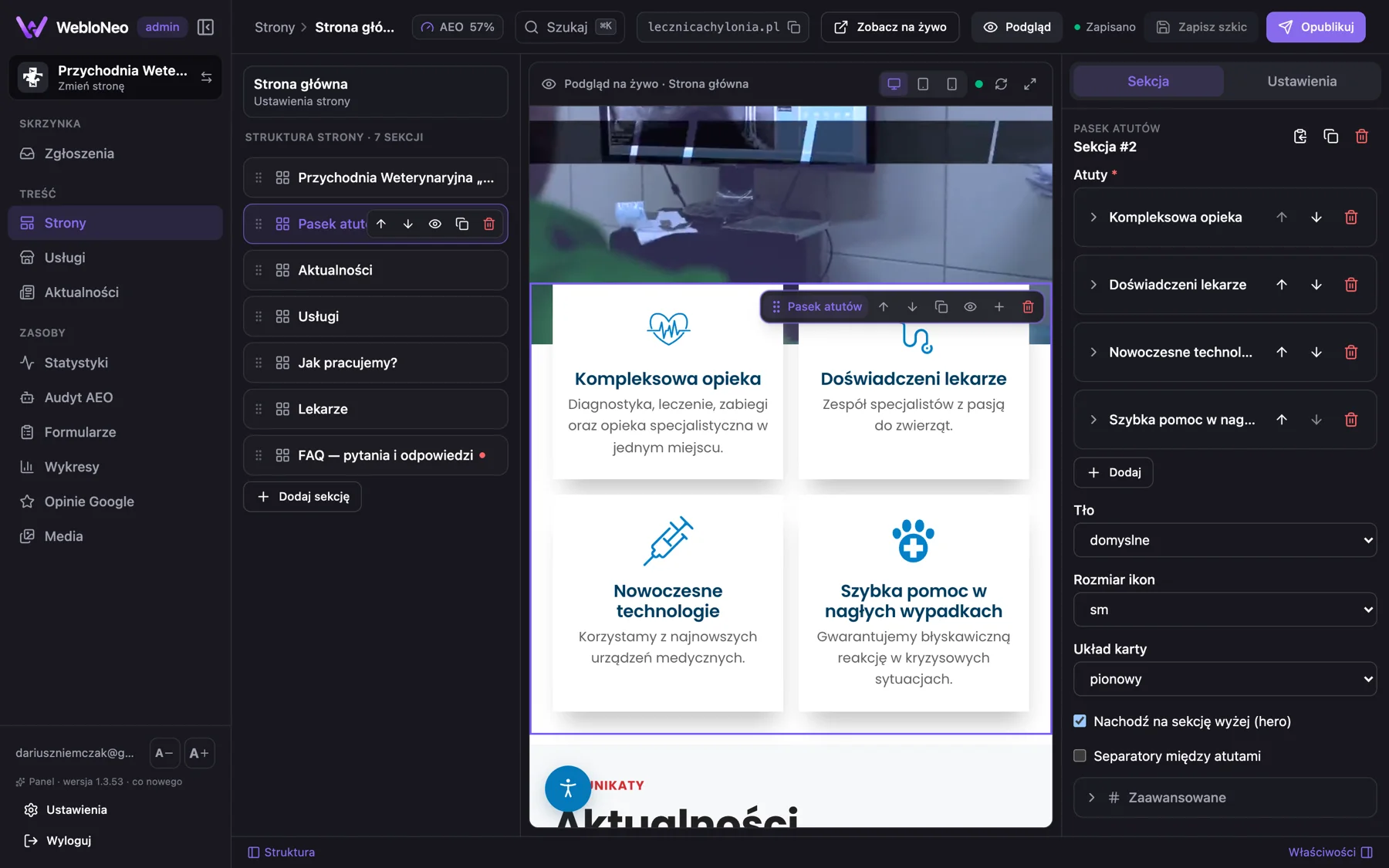
Every NEO Website comes with a panel you use to run it yourself. Content is built from ready-made sections, and the live preview shows the result immediately, before you publish.

There are no plugins to install and no updates to keep an eye on. Everything the site needs is part of one system, and I maintain it.

  • Live preview: You see each change instantly and publish it with a single click.
  • Sections instead of code: You assemble the page from ready-made blocks, so the layout cannot fall apart.
  • From your phone too: The panel works on mobile, including editing and reordering sections.
WebloNeo panel: page editor with live preview
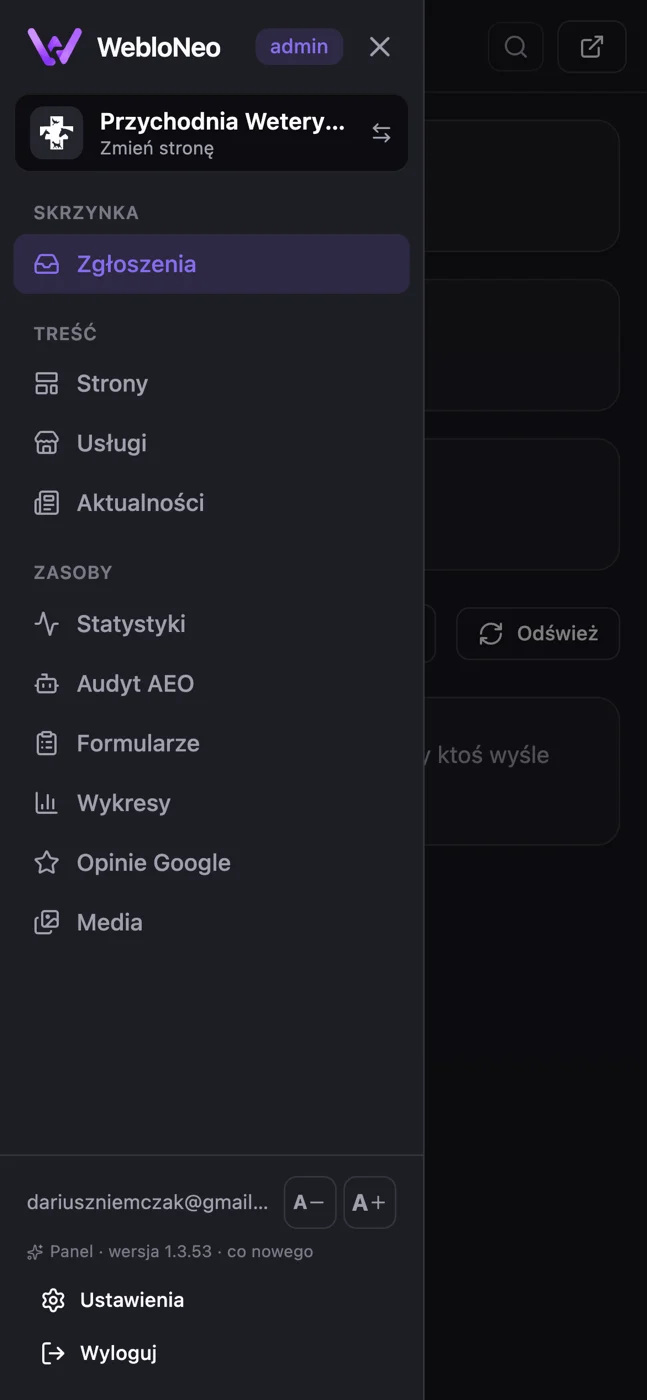
  • The WebloNeo panel menu on a phone

    The menu with the whole site

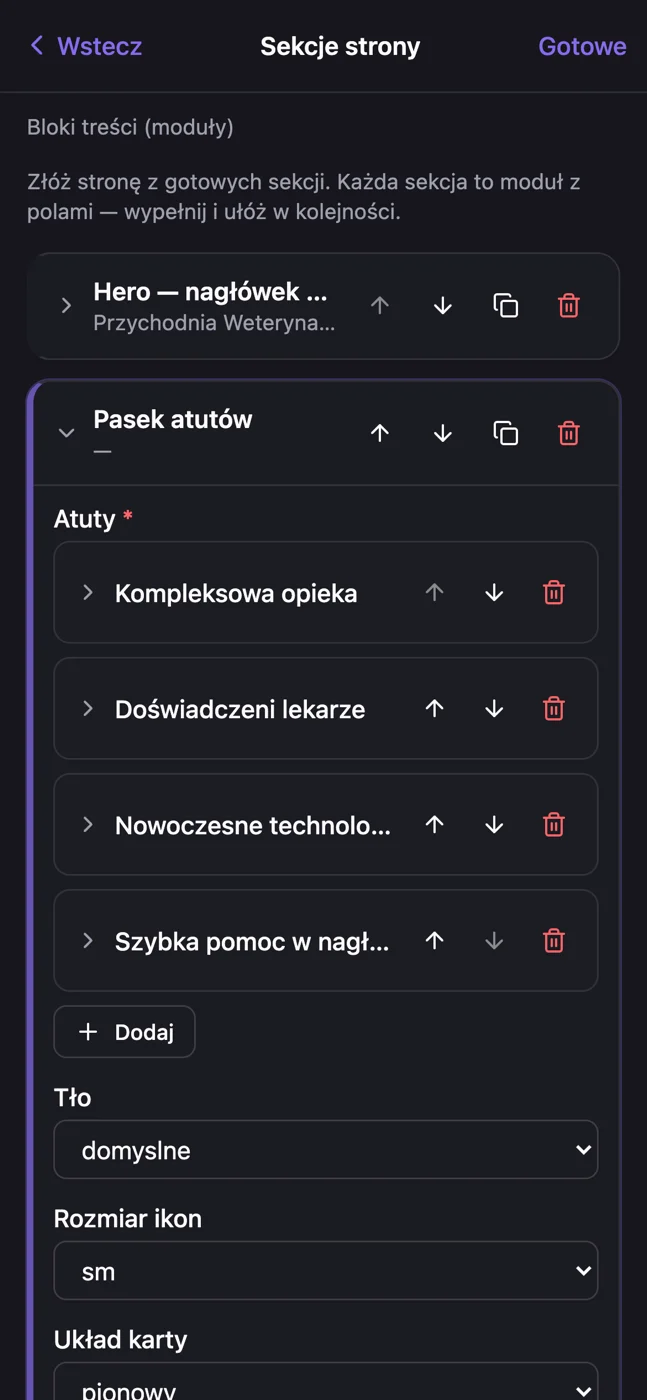
  • Editing a page section on a phone

    Real section editing

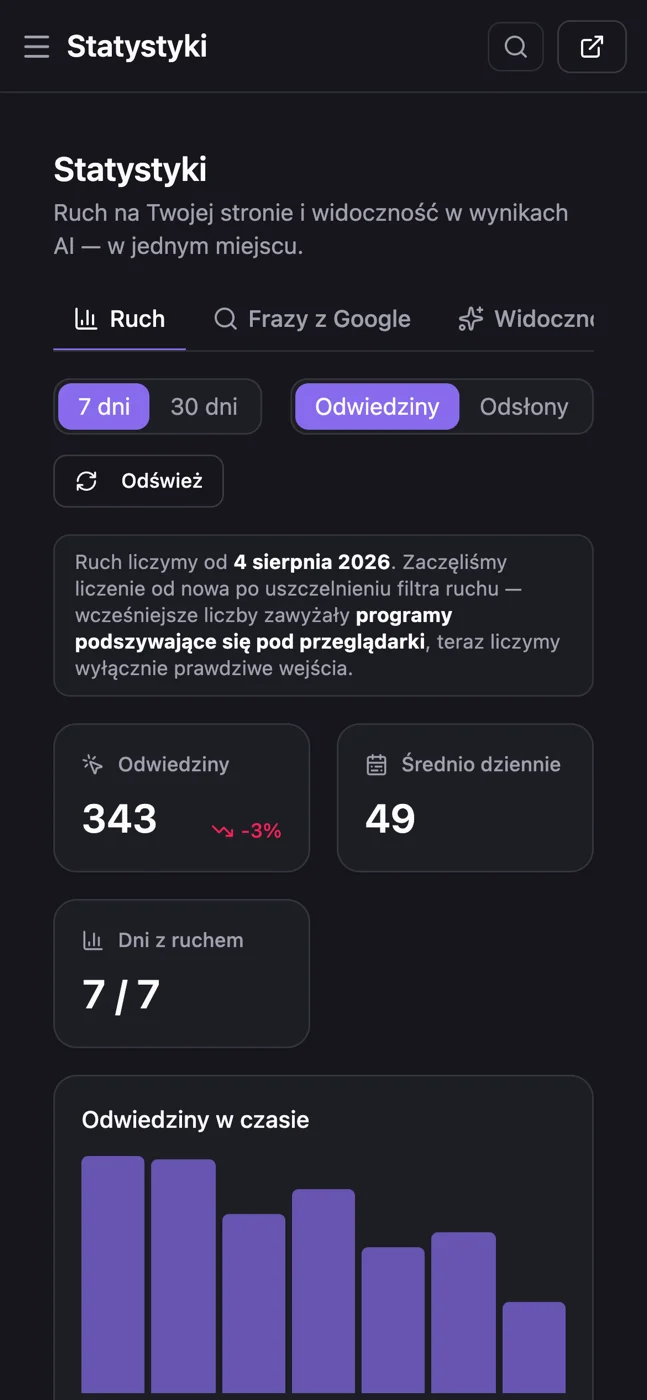
  • Visitor statistics on a phone

    Statistics at hand

From your phone

The whole site fits in your pocket

The panel was built for the phone from the start, not "adapted later". The screens next to this text come from an iPhone and show what you normally cannot do from a mobile: the menu with the whole site, real section editing with reordering, and visitor statistics.

In an ordinary panel, editing from a phone tends to be an ordeal: columns do not fit the screen, side panels cover the content, and dragging elements with a finger loses the drop. The usual advice is: fix it when you are back at your computer.

Here it is the other way round. You fix a price or add a news post while standing on site or in your office. Saving creates a draft and it only goes live once approved, so nobody breaks anything with a single accidental tap.

Two ways of working

You write text like in a notepad

Laying out a page and writing text are two different jobs, so the panel keeps them apart. You assemble the home page or the offer from ready-made sections, while a news post or a guide you write in a plain text editor.

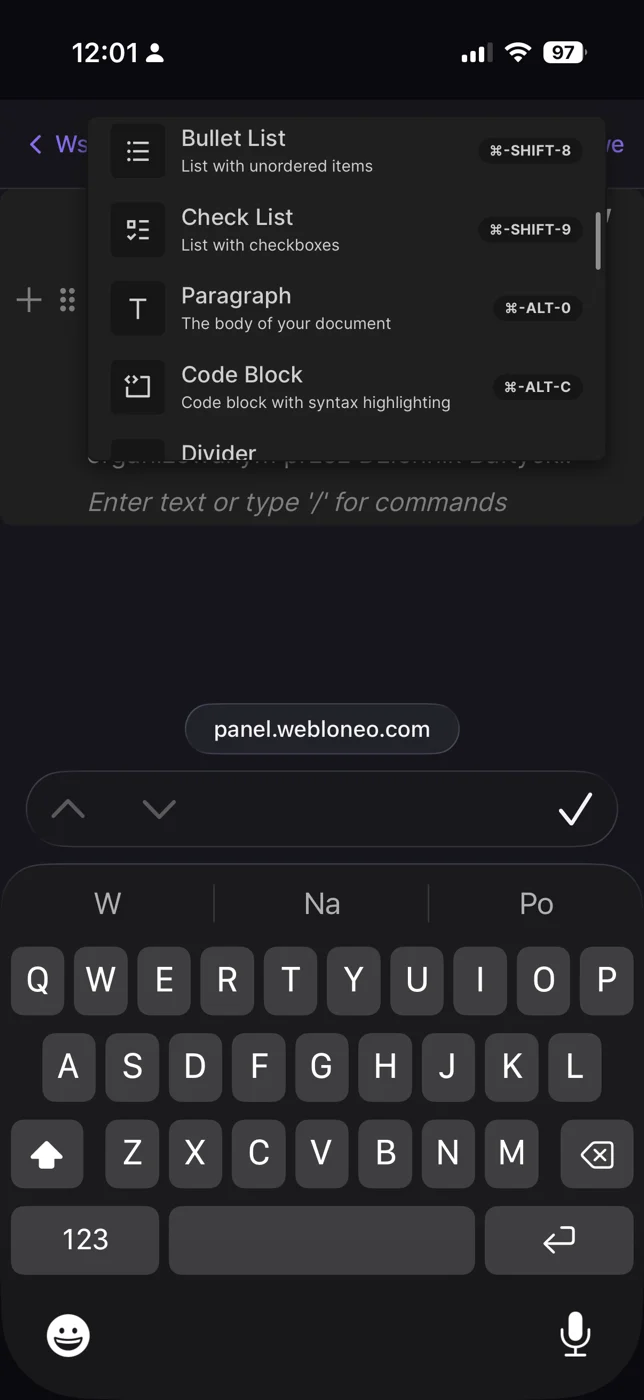
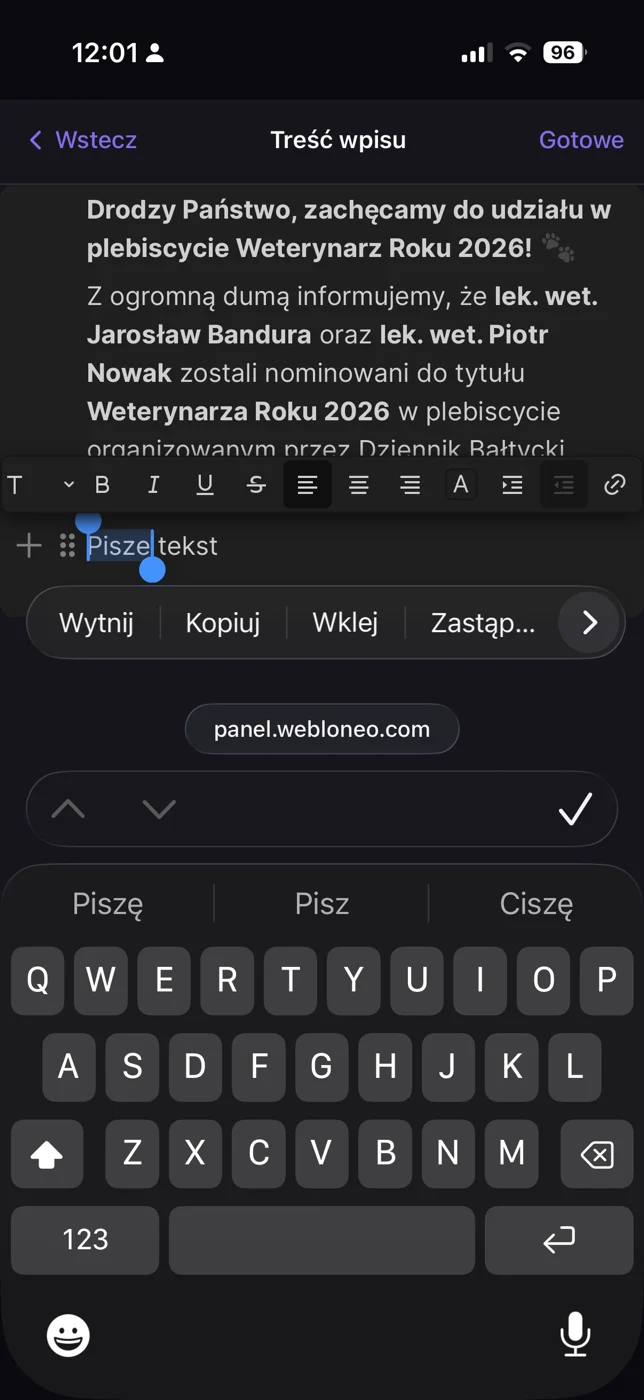
You type a slash and pick what to insert: a heading, a list, a quote, an image. You select a word and a formatting bar appears above the selection. It works the same on a computer and on a phone - the screens next to this text are from an iPhone.

  • No code required : You write the text and pick the formatting from a list.
  • The same on a phone : The block menu and the formatting bar work under your finger.
  • The block menu in the content editor on an iPhone

    The block menu after a slash

  • The formatting bar above selected text on an iPhone

    Formatting the selection

AEO - the new game

Is SEO dead? Not so fast

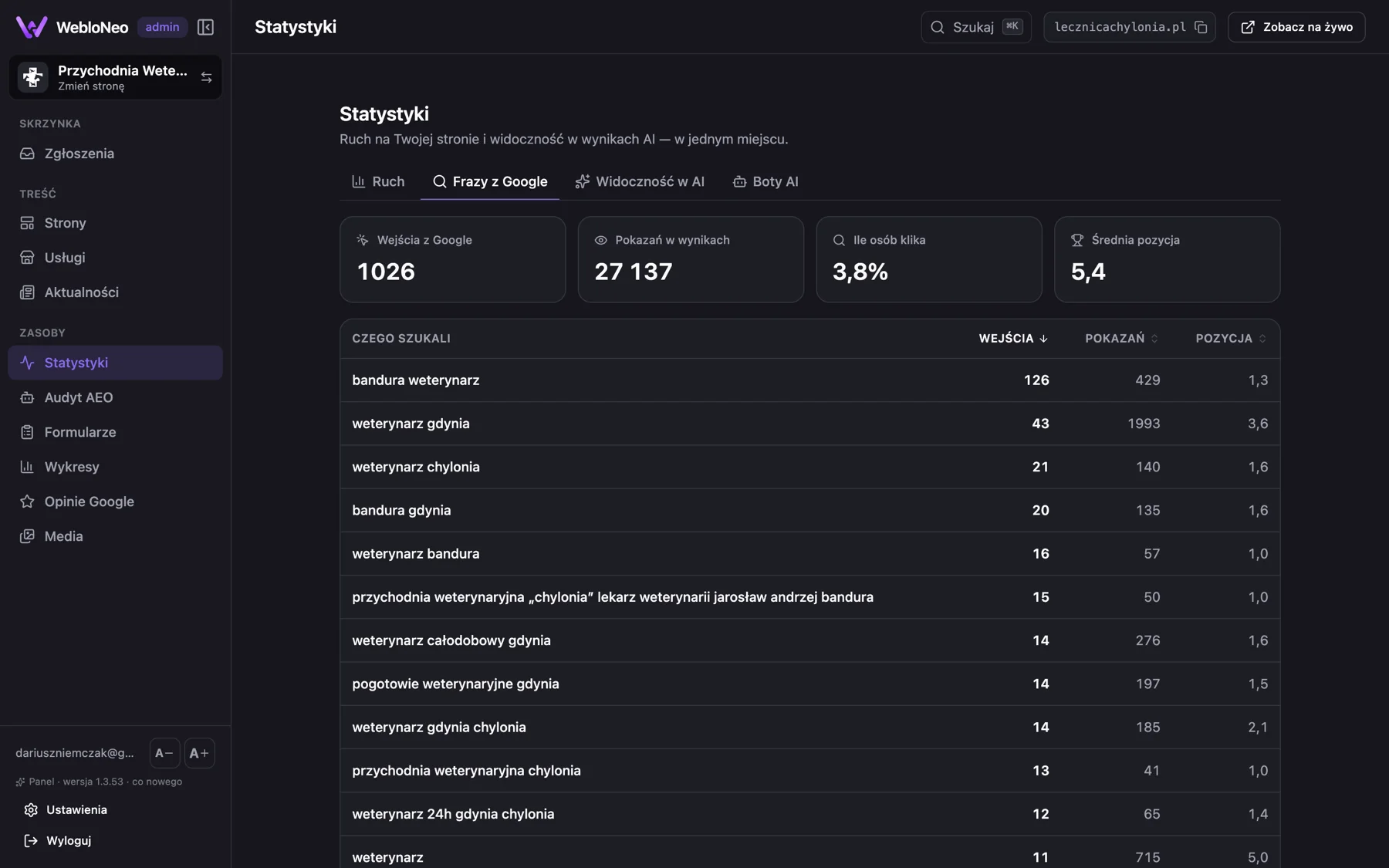
Fewer and fewer people "google". Instead of scrolling through ten blue links, people ask ChatGPT, Perplexity or Google's assistant directly - and get one ready answer. If your company isn't in that answer, to the person asking you simply don't exist. There's no longer a second page of results to fall back to.

That's why classic SEO (the fight for a spot in Google) is no longer enough. It isn't disappearing: it's still the foundation and still matters. But AEO (Answer Engine Optimization) is layered on top - optimizing so that AI search engines understand your content, trust it and serve it as the answer. That's where the traffic is moving, and that's what I build NEO Websites for.

In practice that means specifics: content written in an answer format, complete structured data (schema.org), question-and-answer sections, letting AI bots onto the site and an architecture the model can read. A regular site doesn't have this - a NEO Website has it in its DNA.

WebloNeo panel: the queries the site shows up for in Google

The order has flipped

In Google the AI answer comes first, the classic results only below it

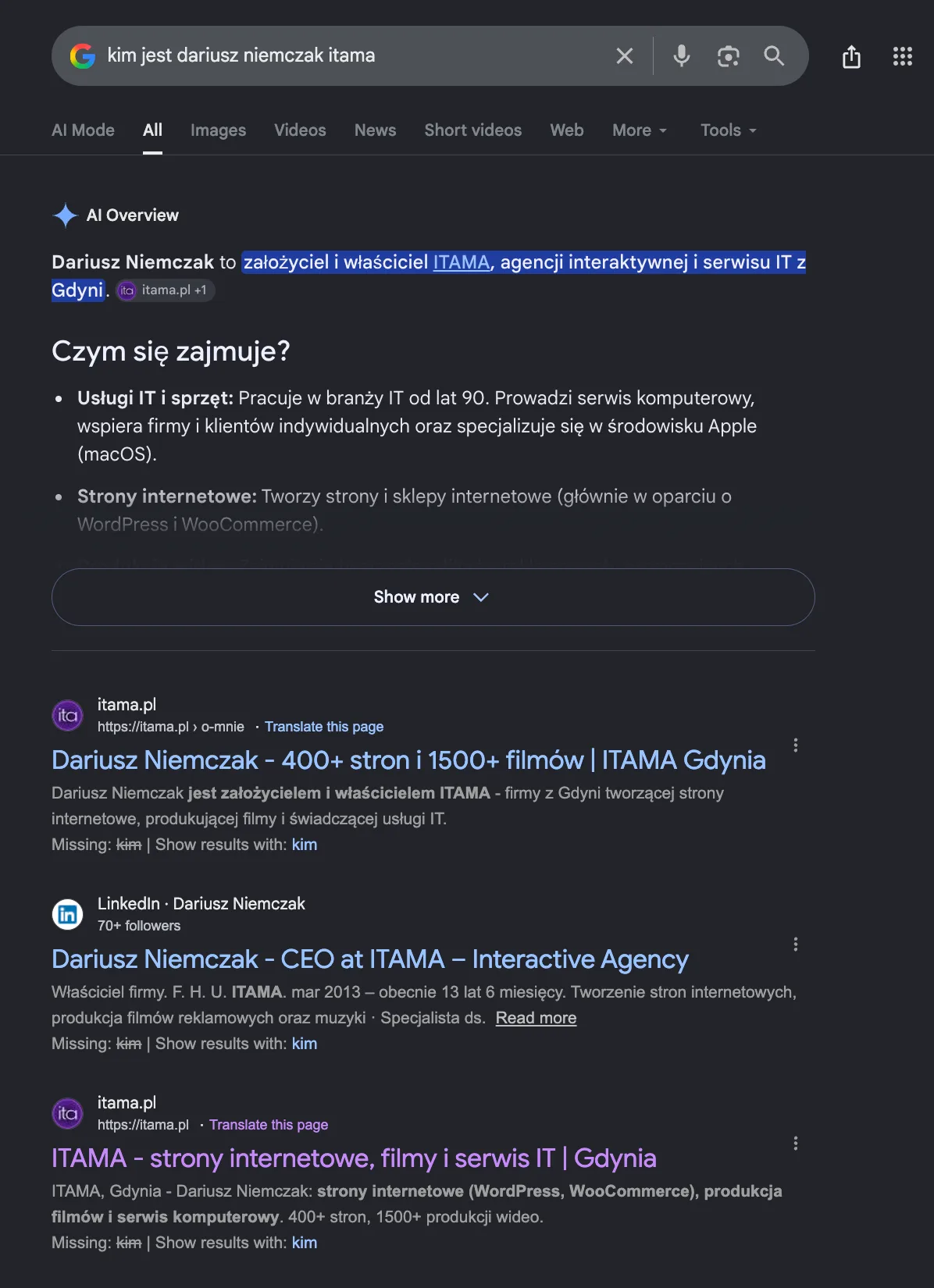
Type a question about a company into Google. Right at the top, before the first blue link, an AI Overview block appears: a ready answer composed by the Gemini model, together with links to the sources it built it from.

That changes the order in which someone gets to know a company. First place in the classic results is now the SECOND answer the person sees. The first one is written by a model, and it takes its material from pages it can read, understand and quote.

I checked this on my own website. Asked who I am and what I do, Google answers with an AI block that quotes my site as its source: scope of services, experience, address. Only below that answer does the classic list of results begin.

  • The model first, then ten links: The AI block sits ABOVE the results, not beside them. More and more often that is where the question ends.
  • SEO decides whether you are on the list: AEO decides whether you are in the answer above the list. Two different questions, and today you need both answers.
  • A model quotes what it understands: Structured data and answer-shaped content decide who it names as the source. That cannot be bolted on with a plugin.
A Google search result: at the top an AI Overview block with a ready answer and links to sources, and only below it the classic list of blue links.

Proof

ChatGPT answers about me, quoting my website

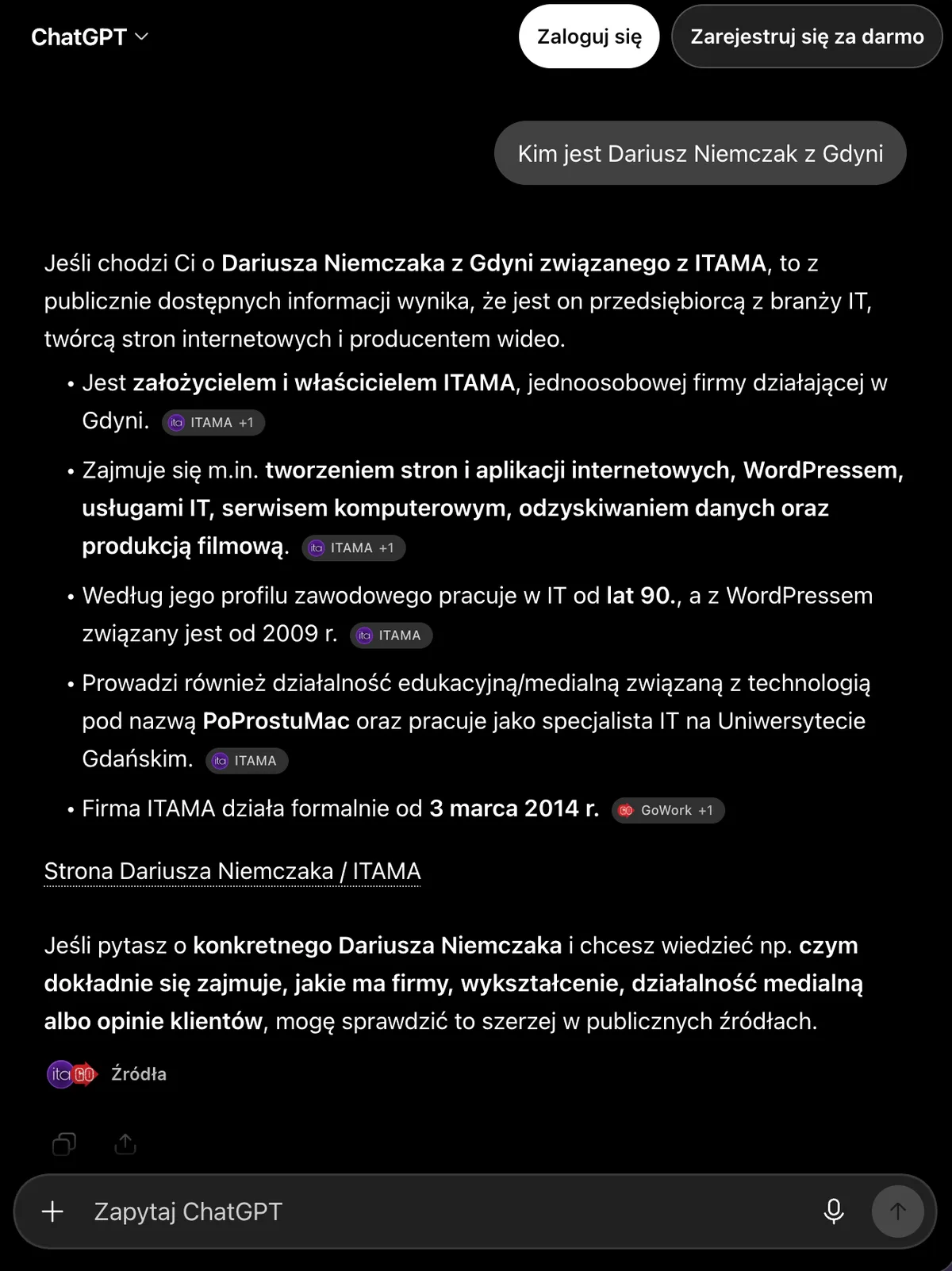
This is not a screenshot from my account or from a paid plan. The question was asked with nobody logged in, in the window everyone sees. The model answers with specifics: what I do, how long I have been working and where I am based.

Every piece of information carries a link to its source. That is exactly the point of AEO: not merely being on the internet, but being the material a model builds its answer from.

  • No login needed: The answer a random person gets, not the one I get on my own account.
  • With links to the source: The model shows where it took each fragment from. That is the trace well-structured content leaves behind.
  • Specifics, not generalities: Scope of services, year founded, location. Exactly what the site states outright.
A ChatGPT answer about the company, built from specifics and linked to the website as its source, in a window with nobody logged in.

Does AI really read the site

You can see it in the numbers, not just take my word for it

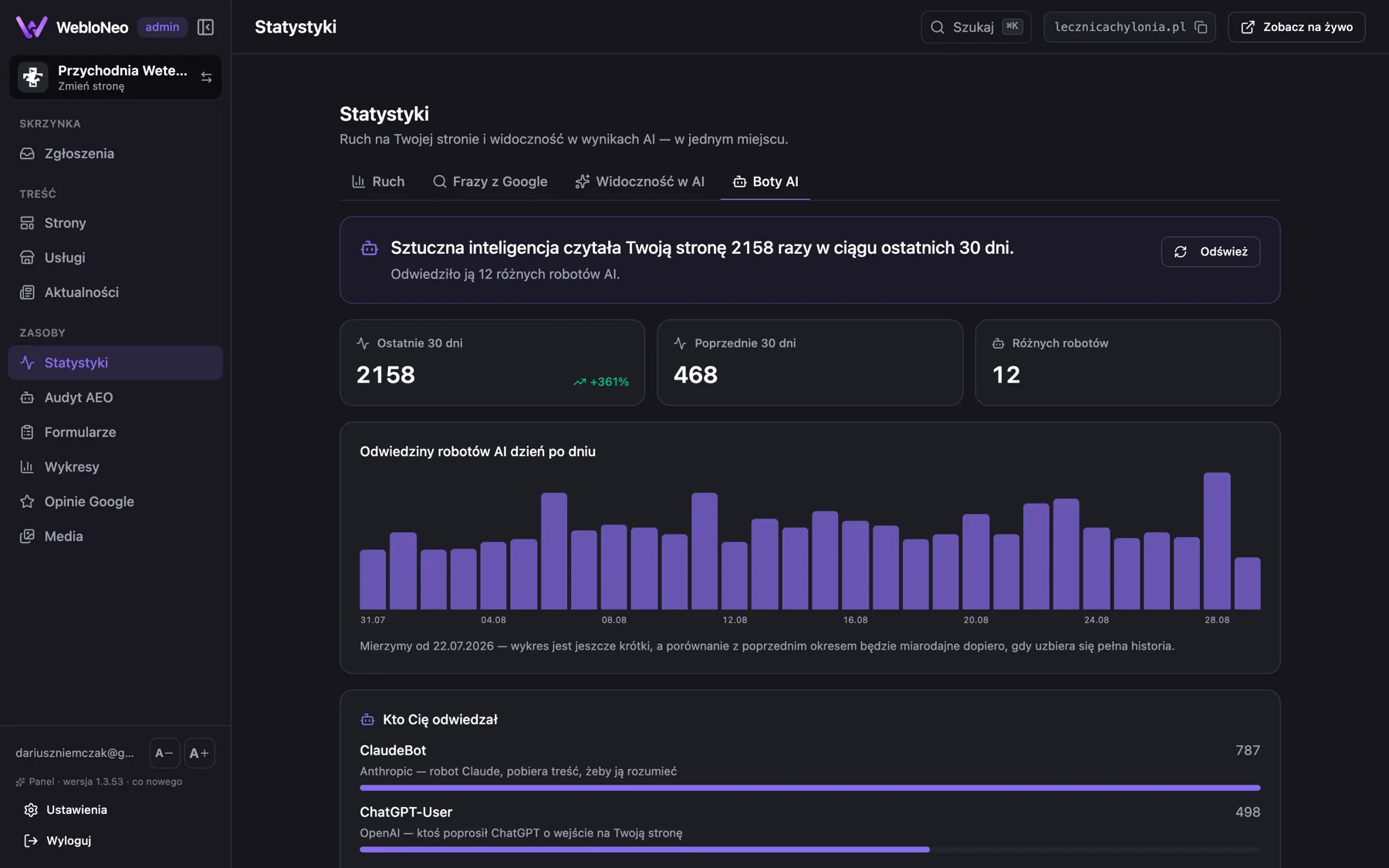
A NEO Website measures how many times AI crawlers actually reached it. You do not have to trust claims about "AI visibility" - you get it counted day by day.

Below is a panel screen from one of the deployments: over thirty days the site was visited by twelve different AI crawlers, including those behind ChatGPT and Claude.

  • You know who came and how often: Every AI crawler listed separately, with visit counts and a comparison to the previous period.
  • AI crawlers are let in: An ordinary site often blocks them without the owner knowing. Here they are allowed in on purpose.
  • No extra tools to buy: The counter is part of the panel, not a separate service to pay for.
WebloNeo panel: counter of AI crawler visits on a client site

Your score, in black and white

A built-in AEO audit

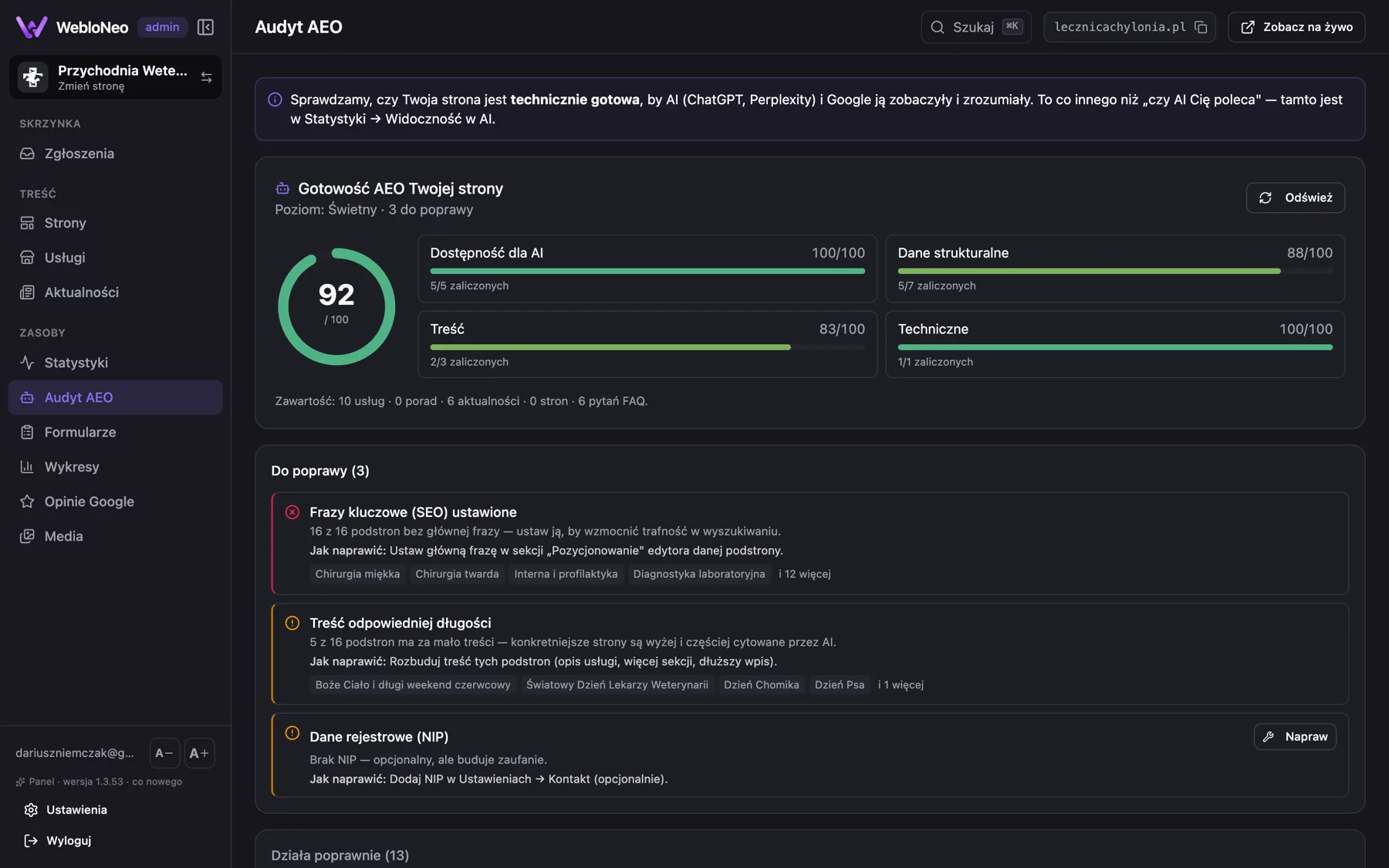
With NEO Websites I plug in my own AEO audit module. Instead of taking my word for it, you get a concrete result: whether AI bots (ChatGPT, Perplexity, Google) can even access the site, whether the content is in a format the model can quote, whether the structured data is complete and whether the site isn't accidentally blocking itself from indexing.

The audit shows the strengths and the gaps and, above all, what specifically to fix so that AI starts recommending you. It's the same measurement I use to check my own deployments, so you know exactly where you stand before you spend a single zloty on ads.

WebloNeo panel: the site's AEO audit score

Results, not promises

This is what Google measures

Anyone can check a site's speed themselves, in a minute and for free, using PageSpeed Insights. Next to this text is the score of a site built on WebloNeo, in the harder mobile test.

The last item, agentic browsing, is a new Google test: it checks whether an AI assistant can actually use the page. A slow or unreadable site simply gets skipped by crawlers.

  • 99 points for performance: Measured on mobile, the stricter of Google's two tests.
  • A full 100 points: For accessibility, best practices and SEO - three categories out of four at maximum.
  • 3/3 in agentic browsing: The page is fully usable by an AI assistant.
PageSpeed Insights result for itama.pl: performance 99, accessibility 100, best practices 100, SEO 100, a full 3/3 in agentic browsing.

The same situation, two routes

What happens before the page appears on screen

A visitor clicks a link. Below is exactly the same event, once on an ordinary site and once on a NEO Website. The difference in the number of steps is also the difference in waiting time.

An ordinary site

  1. Someone opens the page.
  2. A single server wakes up and starts the whole system.
  3. The system queries the database for the text. That is anywhere from dozens to hundreds of queries.
  4. The plugins start up, one after another. Each adds its own queries and its own code.
  5. Only now does the theme assemble the page layout.
  6. The finished page sets off to the visitor.

This work repeats on every visit, for every visitor. That is why speed-up add-ons get bolted on afterwards.

NEO Website

  1. Someone opens the page.
  2. The nearest of the servers placed around the world takes the request and picks up the ready content.
  3. The page sets off immediately. No plugins, no rebuilding from scratch.

Three steps instead of six, and none of them depends on how many add-ons the site has. That is why it is fast from day one.

The difference in short

An ordinary site vs a NEO Website

It is not that WordPress is bad - I build with it myself and it still makes sense. It is that its architecture comes from another era and today charges you for things a well-built site does not need at all.

TopicAn ordinary siteNEO Website
Visibility in AIBuilt for classic SEO. AI crawlers often are not let in, and nobody checks it.Content structured so ChatGPT, Gemini and Perplexity can quote it. The panel shows how many times they reached for it.
What happens on a visitThe page is rebuilt for every visitor. That is why it slows down and needs add-ons to rescue it.Ready and waiting on servers around the world. The browser gets a finished document straight away.
Adding featuresA form, a gallery, reviews, consent - each is a separate plugin by a different author. After a dozen it gets messy.These are part of the system. There is nothing to install, so the tenth feature does not slow the site down.
Updates and securityThe system and its plugins need constant updating. One skipped update is a real risk of a break-in.On your side there are no plugins and no updates. I make a fix once and it appears for everyone at once.
If you change your developerAfter years and several developers the mess builds up: plugins, alterations, other people's workarounds. A new person usually proposes rebuilding the site from scratch.There is nothing to untangle. The content sits in an ordinary database and can be exported.

Overview

The process

  1. 1

    Analysis and goals (AEO-first)

    I establish which questions and phrases you want to compete for - including those asked of artificial intelligence. I design the whole site around the answers your customers are really looking for.

  2. 2

    Content and structure for AI

    I arrange content in an answer format and add structured data and question sections. What's readable for a human becomes quotable for an AI model.

  3. 3

    Building in the SaaS application

    I build the site in WebloNeo, my SaaS application - hence scores close to a hundred in Google's tests and lightning-fast loading. Speed is a real quality signal for Google and for AI.

  4. 4

    AEO audit and launch

    Before launch I run the site through an AEO audit, fix what needs fixing and publish. Then I monitor visibility and keep improving - because AEO is an ongoing game.

Inside the panel

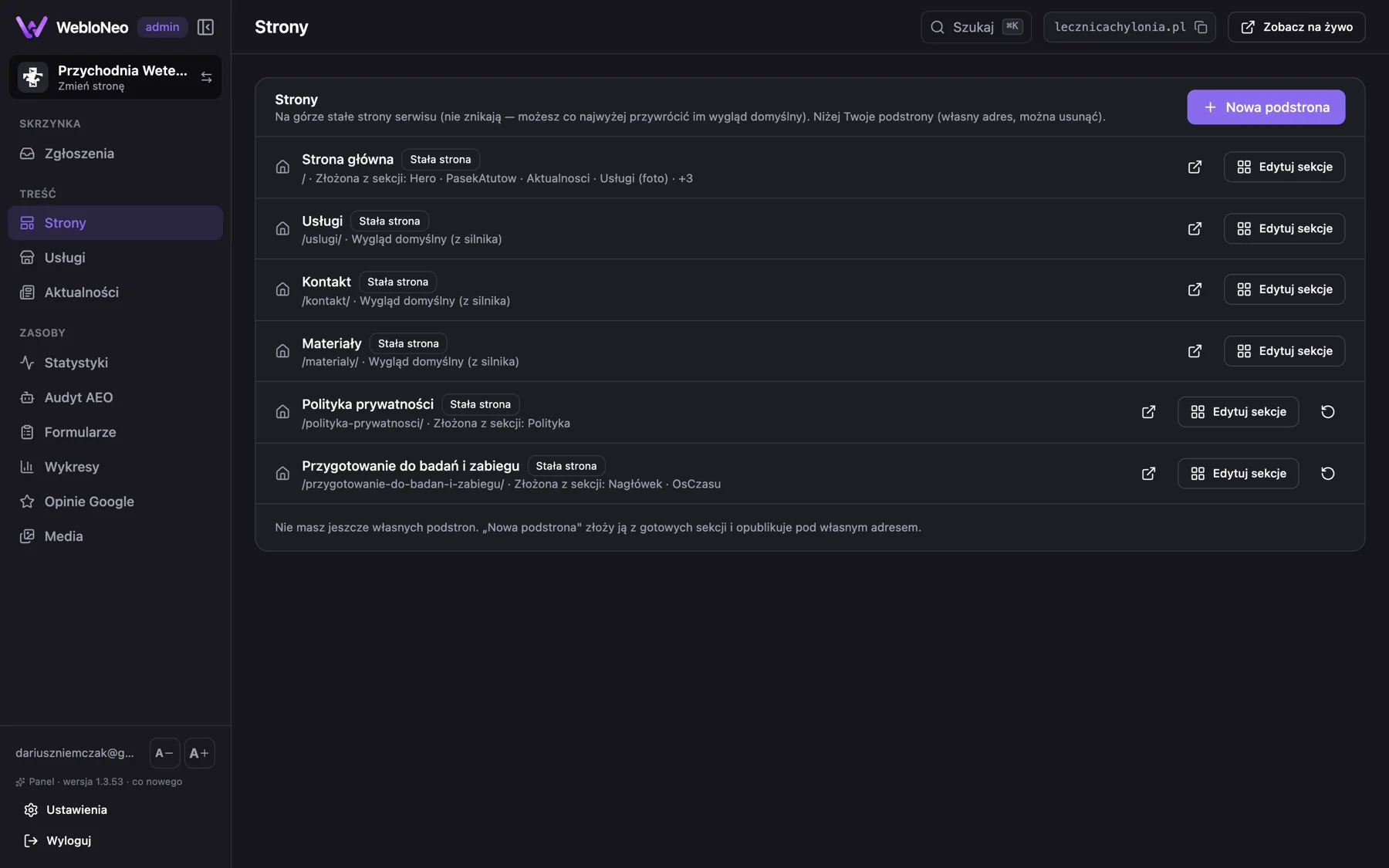
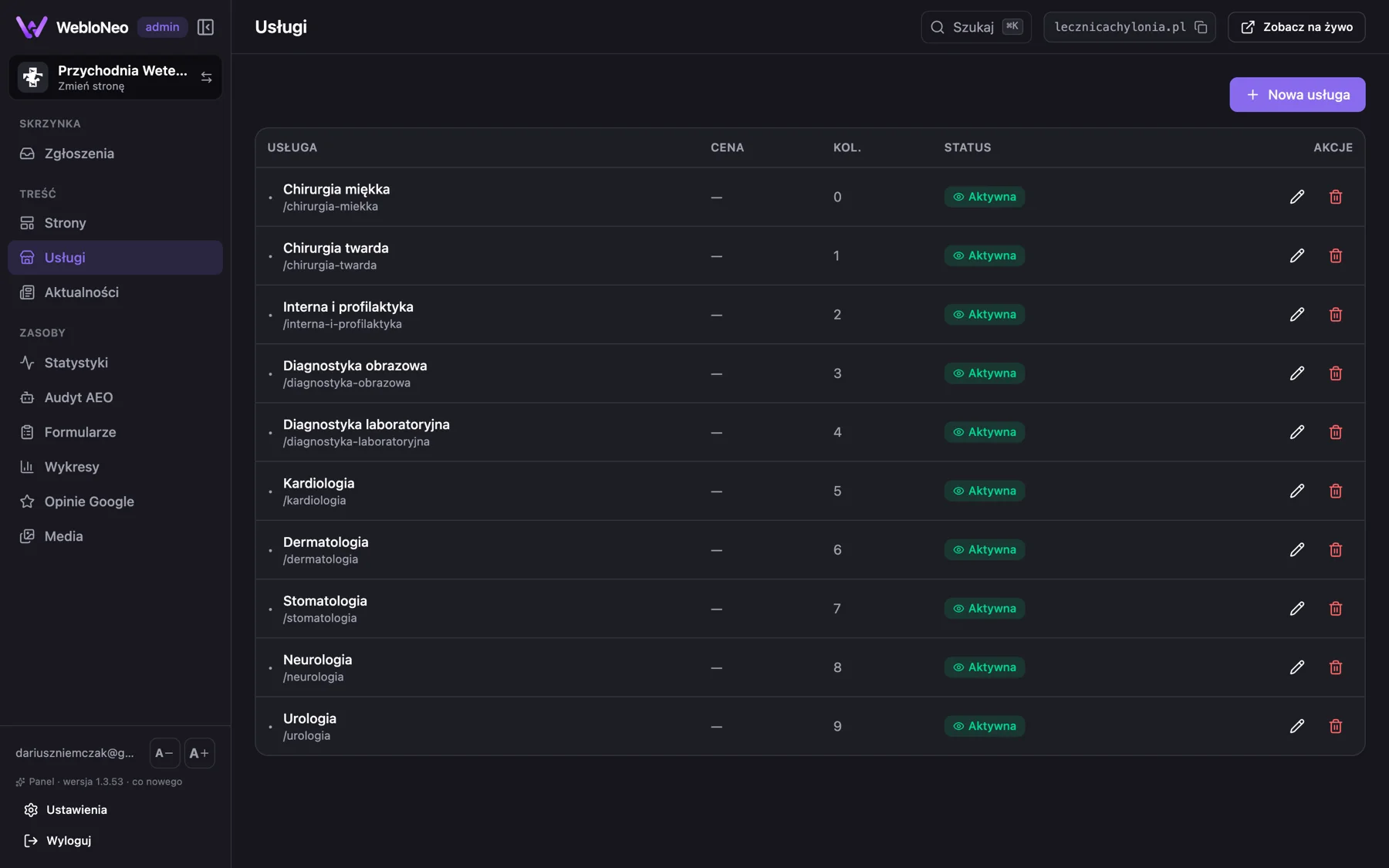
A few screens from the working system. Click to enlarge.

Proof, not promises

NEO Website deployments

Website

Turnkey Interior Renovations and Finishing. GO-Estate

I built the new GO-Estate website from scratch - a company finishing turnkey apartments in the Tri-City area. At its heart is a finishing cost calculator that prices the job for the client on the spot: they enter the floor area, add a kitchen, joinery or coloured walls, and see the ballpark figure right away - instead of waiting for a callback with a quote. Around it: an offer with finishing packages, a portfolio of completed projects, a knowledge section and a quote form. All of it runs on WebloNeo: server-side rendering, a panel for editing content independently, and optimisation for search engines and AI models.

See project
Website

24-hour Veterinary Clinic - Gdynia Chylonia

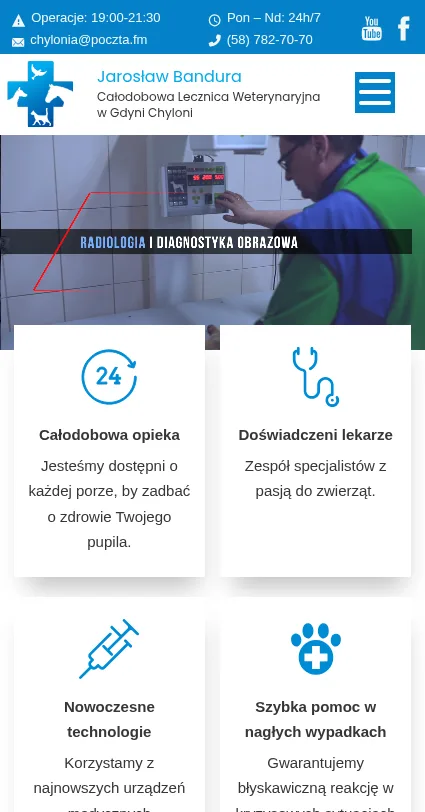
I created a new, modern version of the website for Jarosław Bandura's 24-hour Veterinary Clinic - a surgeon well known across the Tricity. The design improves readability and ergonomics, introduces a visually consistent layout and preserves the clinic's character. An important element is a professional intro spot that engages the user from the very first seconds and builds trust.

See project
Website

Dentist in Gdynia - Maciej Bodal Dental Practice

I built the new website for Maciej Bodal's dental practice in Gdynia from scratch. Each of the six specialities - from conservative dentistry and endodontics to prosthetics and children's treatment - has its own page with a description and an indicative price range, alongside an open price list, patient advice articles and PDF materials to download. The site answers the patient's questions before they pick up the phone. It runs on the same SaaS application as the other projects: server-side rendering, a panel for editing content independently, and optimisation for search engines and AI models.
See project

Frequently asked questions

How much does a NEO website cost, and what about hosting?

Roughly, a NEO website starts from 2500 zł - I quote it individually and for free, and the full service ranges are in the Pricing page. Bundled in you get Premium hosting tuned for NEO, with the first year free (then 400 zł / year). So you do not pay separately just to have the site simply run lightning-fast.

How does a NEO Website differ from a regular WordPress site?

In its foundation and its goal. A regular site fights for a spot in Google and is often heavy with plugins. A NEO Website runs on a dedicated SaaS application (hence scores close to a hundred in Google's tests) and is built for AEO - so that AI search engines recommend it too. I still build WordPress where it makes sense; NEO is the option for companies that want to get ahead of the competition.

What is AEO?

AEO (Answer Engine Optimization) is optimization for "answer engines" - ChatGPT, Perplexity, Google AI. When someone asks an AI about a company or service, the goal is for the model to know you, understand you and recommend you specifically. It's the next step after SEO - and it's exactly where customers are moving.

Is SEO still needed?

Yes - SEO isn't dead, it's just no longer enough. A good spot in Google is still the foundation and part of the package. I layer AEO on top: first solid technical SEO, then visibility in AI. One reinforces the other.

Will my site show up in ChatGPT or Perplexity answers?

I build the site exactly for that: I let AI bots in, serve content in an answer-ready format and complete structured data. No honest person will guarantee a specific model answer - but without these foundations you're invisible to AI, and with a NEO Website you're playing for it on the best possible terms. The AEO audit shows where you stand.

What do high scores in Google's tests actually give you?

Faster loading (fewer drop-offs), better accessibility, a higher technical rating from Google and a strong quality signal for AI too. The customer doesn't "see" these numbers directly, but feels the effect: the site loads instantly, runs smoothly on a phone and inspires trust from the first second.

Want a website that AI recommends too?

Tell me about your company - I'll show you how a NEO Website can give you an edge: speed proven by Google's tests and visibility in AI search engines. I'll start with an AEO audit so you know exactly where you stand.