
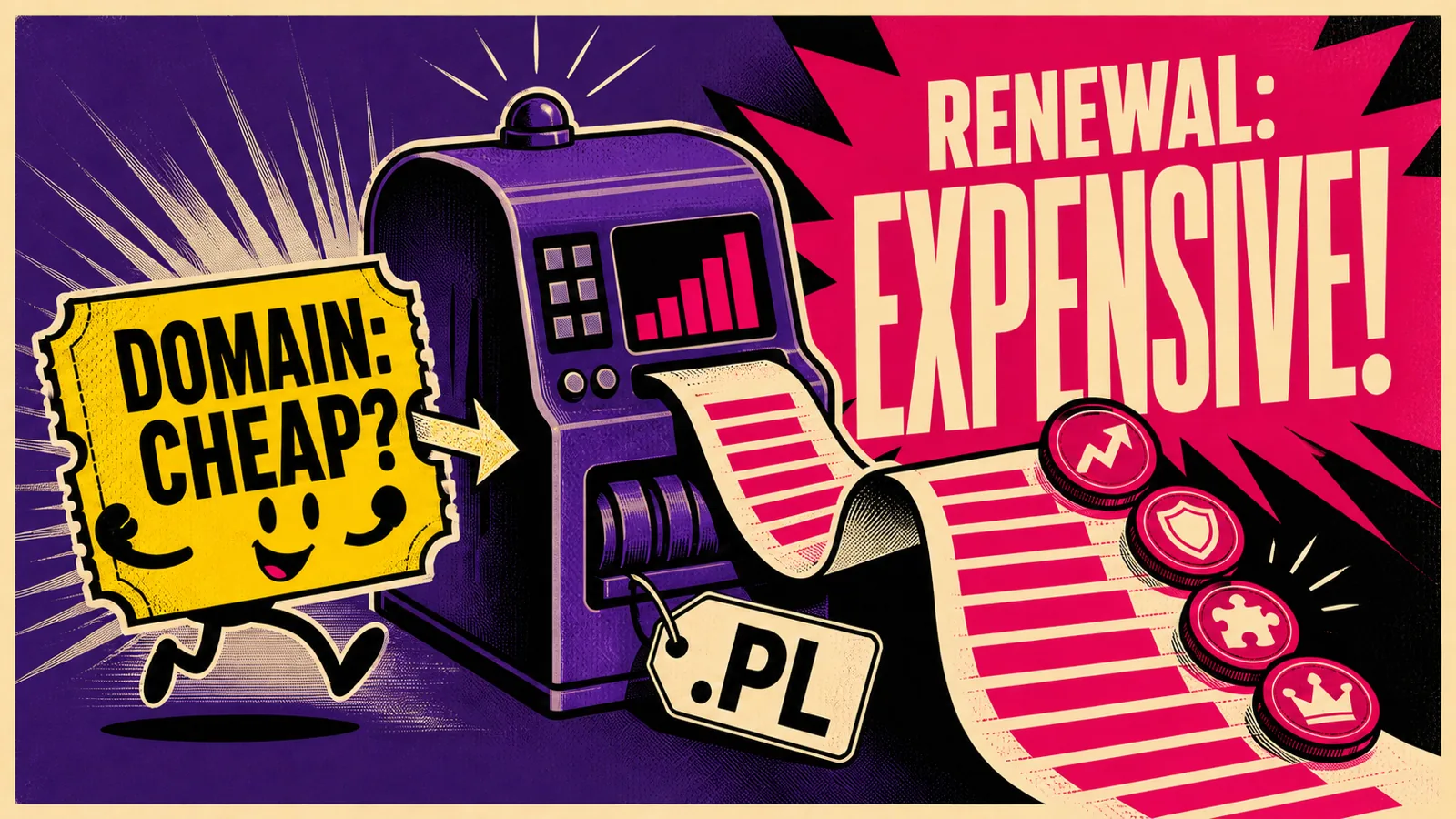
Short answer: on the domain itself, the big operators earn the least. They earn on what happens after the first year: on a renewal priced several times above the market rate, on surcharges for things that are standard elsewhere, and on the fact that leaving is inconvenient or expensive. One of the companies I am moving now paid about 3,200 PLN a year this way for domains, email and a server (I broke the whole bill down here). Companies that have moved to me pay at most 450 PLN net a year afterwards, including the care of several mailboxes.
I name no names. I describe the tactics, and you will recognise them in your own price list within ten minutes. All of them come from public customer reviews, from terms and conditions that anyone can read, and from the invoices of companies that come to me.
The phone call I take most often
"Darek, I used to pay 123 PLN for this domain. Now an invoice came for 260. Last year somebody else showed me one for over 300. For the same thing. What is going on here?"
What is going on is that the price of a domain at a large operator is not the price of a domain. It is the price of a bundle in which the domain is merely the label, and the rest are line items nobody ordered: DNS maintenance, handling of an "external" domain, a starter package, renewal at the new rate. The wholesale registry fee for a .pl domain is 50 PLN net per year, and it does not change. Everything above that is the operator's decision, not a cost.
Tactic 1: cheap registration, expensive renewal
A .pl domain costs the registrar 50 PLN net per year, because that is what the NASK registry charges. That is the floor below which nobody makes money. Market renewals usually sit between 60 and 99 PLN, while the most expensive operators can reach 200-300 PLN net for the very same domain.
That is why a domain "for 9 PLN" is not cheap. It is financed: the first year is the cost of acquiring a customer, and it comes back with interest on every year after that.
I went through this myself as a customer. My bill with a company like that started at about 400 PLN a year, and a few years later it was about 1,500 PLN. That is when I moved out.
How to check: in the price list, look only at the "renewal" or "extension" column. The registration price is irrelevant, because you pay it once in your life, while you pay the renewal every year for the next decade.
Tactic 2: the domain only comes in a bundle
Customers describe situations where you cannot renew the domain on its own: to renew it you have to buy or keep services you do not use. Domains are also sometimes sold only together with hosting or with a "starter package".
This is not a system fault. It is a design: the single item you would like to pay for is not available separately.
How to check: log into the panel and try to renew the domain only, with nothing else attached. If you cannot, you already know.
Tactic 3: a surcharge for DNS and the certificate
DNS is not an add-on. It is the mechanism that lets a domain know where the website stands and where mail should go. Without working DNS, a domain is a registry entry and nothing more.
It is nevertheless sometimes sold separately, under names like "anycast DNS" or "premium DNS", with an argument about speed and resilience, often together with DNSSEC (a signature confirming that the domain's records are genuine). The argument is true, it is just that with many providers exactly that kind of DNS is included and costs nothing. So you are paying for something that is standard elsewhere.
An example from the invoice of a company I am moving now (gross amounts): a .com.pl domain in a "secure domain" package (DNSSEC and Anycast DNS) costs 295 PLN a year. At a cheaper registrar, renewing the same domain costs about 53 PLN.
The SSL certificate (the padlock next to the website address) is a similar story. Today it is free and renews itself, yet the same invoice shows a paid certificate for 185 PLN every six months, which is about 370 PLN a year. On top of that, for a domain that only redirects to the main website.
Tactic 4: you get punished for buying the domain somewhere else
This is the tactic customers ask me about most often. And the one that stings most, because it hits people who tried to do the right thing: they bought the domain more cheaply at a cheaper registrar and left the hosting with a large provider.
And then it turns out that the large operator also charges for keeping that "foreign" domain pointed at them. The line on the invoice goes by various names (domain parking, external domain maintenance, DNS handling for a domain outside our offer, DNS package), but the mechanism is one: you pay extra because the domain was not bought from them.
On the invoice of the company I am moving now, a separate DNS service like that for a domain outside their offer costs 12 PLN this year on promotion, and usually about 100 PLN a year. That is more than a yearly .pl renewal at a cheaper registrar (about 73 PLN gross). A domain bought from them comes with DNS included, so a cheaper domain from elsewhere gets you nowhere 😳
That is where those phone calls about figures that make no sense come from:
- 123 PLN, back when there was still a promotion, or the domain sat with a cheaper operator without extras,
- 260 PLN, when "maintenance" and DNS were added to a list-price renewal,
- over 300 PLN, when a bundle item or a late-restoration fee joined them.
Every time we are talking about the same registry entry, which costs the operator 50 PLN net per year.
And now the most important sentence in this article: technically, that fee is not needed for anything. Pointing a domain at someone else's hosting is a single change of name servers in the registrar's panel. It takes a minute and costs nothing. There is no service in it that anyone has to pay for. There is a fee for being allowed to buy elsewhere.
How to check this on your own bill: take the last invoice and work out how much of the total is the domain itself according to the renewal price list, and how much are the items around it. If your domain is with one operator and hosting with another, check especially whether either of them charges you separately for "handling" the other side of the arrangement.
Tactic 5: a penalty for leaving
The most painful one, because it only surfaces when you move out. Public customer reviews point to three variants:
- promotion terms with an obligation to renew: you took the cheap registration, so you owe another period, and transferring to another operator means paying anyway (the figures described are in the region of 300 PLN),
- a domain restoration fee once the payment date has passed: a separate item on top of the renewal price,
- an obstructed
authinfocode: with some providers you click it in the panel and have it instantly; with others, customers describe delivery by post and a wait measured in weeks.
How to check before buying, in a minute: look in the panel and see whether the transfer code is available on your own. The absence of that option is information in itself.
Tactic 6: a pro forma with items added on
Renewals can be charged automatically, and the payment document generates itself. Customers describe items they never ordered, added services, and bills on which the domain gets lost among the extras. With one of the large providers, paying online from the panel adds a fee for the payment itself. A regular bank transfer from the pro forma does not have it.
Formally everything is in order: a pro forma is not an invoice, and not paying for an item counts as declining it. In practice, you will pay the whole thing, because nobody has time to work out which of the eight lines is actually needed.
The rule: before you pay anything for a domain, check three things: whether the sender is your registrar, whether this is an invoice or an offer, and whether every item on the document is something you actually need.
Give yourself a ten-minute audit
- List every domain you pay for, including the "just in case" ones.
- For each: who holds it, what the renewal costs, when it expires.
- Check whether DNS is included or charged extra. The same goes for the SSL certificate.
- Check whether you can renew the domain alone without buying anything else.
- Check whether the authinfo code is available in the panel.
- Work out the difference against a market renewal of 60-99 PLN times the number of domains times three years.
Point six usually makes the biggest impression. Three domains and a difference of 150 PLN on each is 1,350 PLN over three years, for exactly the same registry entry, identical at every operator.
If you also pay for a mail server, work out the whole bill, not just the domains. A service billed every quarter is easy to overlook, and once converted to a year it is often the biggest item. I show how to do it from your invoices in fifteen minutes in a separate article: 3,200 PLN a year for a server and domains.
How I help with this
I do not sell domains and take no margin on them, which is why I can tell you plainly where to buy them cheaper. I do three things:
- An audit of what you have: which domains, with whom, when they expire, what they really cost and which invoice lines are a surcharge for nothing.
- Moving them somewhere cheaper, with no interruption to your website or mail. I described the procedure in how to move a website to another host.
- Tidying up the mess left by predecessors: one place instead of four, a company contact address, reminders about deadlines. The domain remains your property, and I am only the person who knows where to click.
Want to know how much you are overpaying? Write to me and give me your domains. I will send back a three-year calculation: what you pay now, what the same would cost elsewhere, and whether moving makes sense in your case. Sometimes I reply that it does not, because a difference of a few dozen zloty a year is not worth the disruption. I charge nothing for checking.
More on how a domain price is actually built: what a domain really costs. And if your domain was once registered by a friend or an IT contractor, read who owns your company's domain, because that is a separate problem and it can cost more than every surcharge combined.
Frequently asked questions
Is a cheaper registrar a worse registrar?
A .pl domain is an entry in the NASK registry, identical regardless of where you buy it. What differs is the price and the service, not the domain.
I pay for "anycast DNS". Do I need it? Distributed DNS is a good thing, but many providers include it at no extra charge. A separate line item for it makes sense in genuinely rare cases.
Does moving a domain risk downtime for my website or mail? No, provided it is done in the right order: email and destination DNS first, then the transfer of the domain itself. If the domain has DNSSEC switched on, remove it before changing the DNS servers, on a quiet day.
When is the best time to move? Two to six weeks before the renewal date. A transfer usually extends the domain by a year, so you do not lose the period you have paid for.