
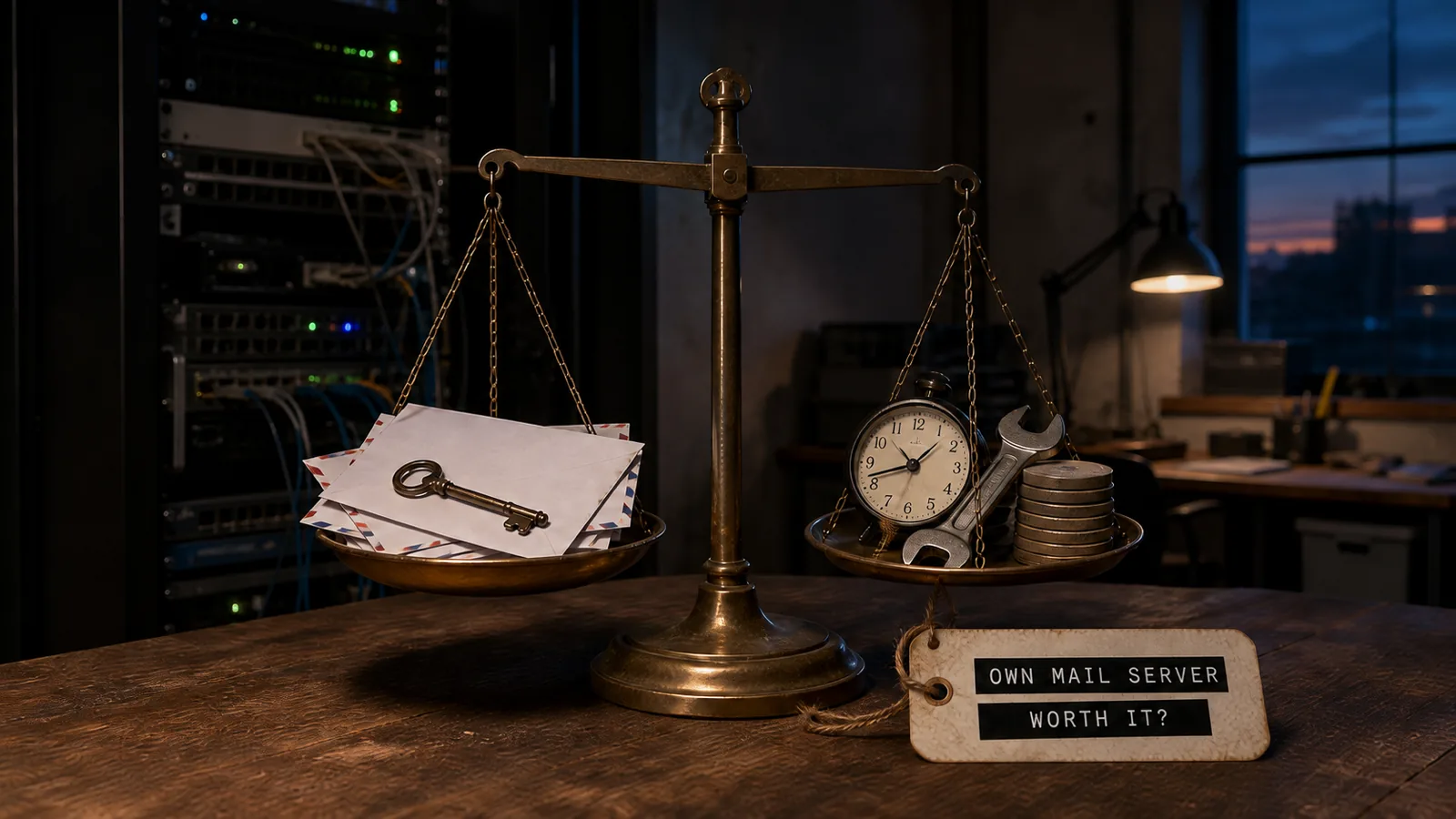
Short answer: running your own mail server for a single company usually does not pay off - what does pay off is to stop treating email as something that cannot be touched. The difference lies in who holds your messages and whether you can take them away.
I am writing about this because the question keeps coming back after Google's announcement: Gmail is dropping fetching from external mailboxes, and suddenly it turns out that company correspondence has for years lived somewhere nobody has any influence over.
What is wrong with the current arrangement
A typical small company has mail "bundled with hosting" and reads it in Gmail or Outlook. It works - until the day when:
- the provider changes the rules or switches a feature off (exactly what is happening now),
- the mailbox runs out of space and mail starts bouncing,
- an employee leaves, and the history of their correspondence disappears with their computer,
- you need to find something agreed three years ago, and search only shows the last six months,
- the company grows to five addresses and nobody knows which one the client wrote to.
These are not outages. This is the normal life of a company mailbox - which is exactly why it is worth thinking about before it hurts.
What a mail server of your own really costs
| Component | Cost |
|---|---|
| Server (VPS, 2 cores / 4 GB) | about 25-35 PLN a month |
| Domain | see: what a domain costs |
| Configuration: SPF, DKIM, DMARC, IP reputation, spam filtering | one-off, and this is the hard part |
| Maintenance | updates, monitoring, backups - every month, by somebody |
The hard truth: the hardware cost is laughably low, the cost of knowledge is not. A mail server that delivers to Gmail and Outlook without landing in spam requires correct authentication records, a clean IP address and constant attention to reputation. Standing one up in an hour is not the problem. The problem is that six months later your invoices stop reaching clients and nobody knows why.
That is why I do not recommend a mail server of your own to a single small company. It is usually recommended by people who have never taken a nine o'clock phone call asking "why didn't you get my email".
A sensible middle road
Separate the three things that are usually glued together:
- Where mail arrives (the provider's mail server, or Google).
- Where it is stored and for how long.
- What you read it with.
The biggest gain is in point three, because that is where the daily irritation lives: switching between tabs, search that only goes so deep, and five addresses in five places.
What I am building: MSG NEO
MSG NEO is an email program that gathers company mailboxes into one place on your side, rather than in somebody else's account. In practice:
- several mailboxes in one window (
biuro@,zamowienia@,ksiegowosc@) while preserving which address each message arrived at, - search across the whole history, not just the last few weeks,
- spam filtering and a quarantine,
- a desktop application - macOS and Windows, with an iPhone version to follow,
- the mail stays with you: the copy sits where we put it, and nobody changes the rules mid-game.
The first mailboxes go live in January. If you have to change something anyway because Gmail is switching off mail fetching, this is a good moment to change once rather than twice.
Want to be on the list of first users? Write to me with "MSG NEO" in the message. I will get in touch when it is ready - and if along the way I conclude that forwarding at your provider is enough in your case, I will say so plainly.
Frequently asked questions
Is your own mail server more secure? Not in itself. It is more yours - meaning both the benefits and the obligations sit on your side.
Will I lose access to old mail when switching? No, provided the move is done over IMAP: messages are copied along with their folders. That is a standard part of migration.
What about GDPR? Company email contains personal data regardless of where it sits. What matters is the contract with the provider and where the data physically resides - with your own infrastructure you know that exactly.
Do I have to change email addresses? No. Addresses belong to your domain, not to the provider - one of the few things in this puzzle that are entirely yours.